
It’s Wednesday as I write this. November 11th. Remembrance Day number 108. I have been alive for 71 of them. I walk outside my office in the busyness of Foodbank day today, and it’s business as usual. Animated conversations and the usual laughter and banter of people interacting in the foyer. There are people coming and going … it’s busy. Always busy.
But it’s Remembrance Day.
It’s nearly 11:00 am. But it’s business as usual. There is no pause. There’s only busyness. At 11:00 am on the dot, I sit at my desk, head bowed remembering our service men and women who served in World War I and World War II, and Korea, and Afghanistan, and Vietnam, and Somalia, and … Who paid the ultimate price to serve our nation. Roughly 62,000 Australians lost their lives in World War I. The official Australian War Memorial Roll of Honour records 61,727 deaths as a direct result of battle. 62,000 lives ripped out of a population of just 4.9 million back then and of those, 2.5 million were men. To stop and reflect just now, this was a staggering price to pay for freedom. Our modern nation was not even 20 years from federation. Another 155,000 Australians were wounded or gassed, and 4,044 were taken as prisoners of war. Roughly two-thirds of all Australians who served overseas became casualties, representing one of the highest casualty rates among the Allied forces. And that’s just for WWI!
For such a young country we have been in many wars and conflicts now – none of our own making. In World Wars I & II, Australia was definitely fighting for democratic freedom, including our own. World War I was supposed to be “the war to end all wars”. That concept is widely attributed to British writer, H.G. Wells, who used the phrase in a series of newspaper articles in 1914 (later collected into a book titled The War That Will End War). He blamed German militarism and argued that defeating the ‘Central Powers’ would pave the way for a permanent global peace. At the time, the sheer scale of death, trench warfare, and apocalyptic destruction led people to believe that humanity would never again allow such a catastrophic conflict. But less than 25 years later WWII ignited. That war cost the lives of 25 million armed forces personnel (including prisoners of war), and another 70 million civilian lives.
And so, it is imperative that we stop what we are doing on Remembrance Day and reflect –just for one minute at 11:00 am, in all our busyness – and remember the sacrifices made, grieve for the sons and daughters lost to our nation, and humble ourselves and pray …
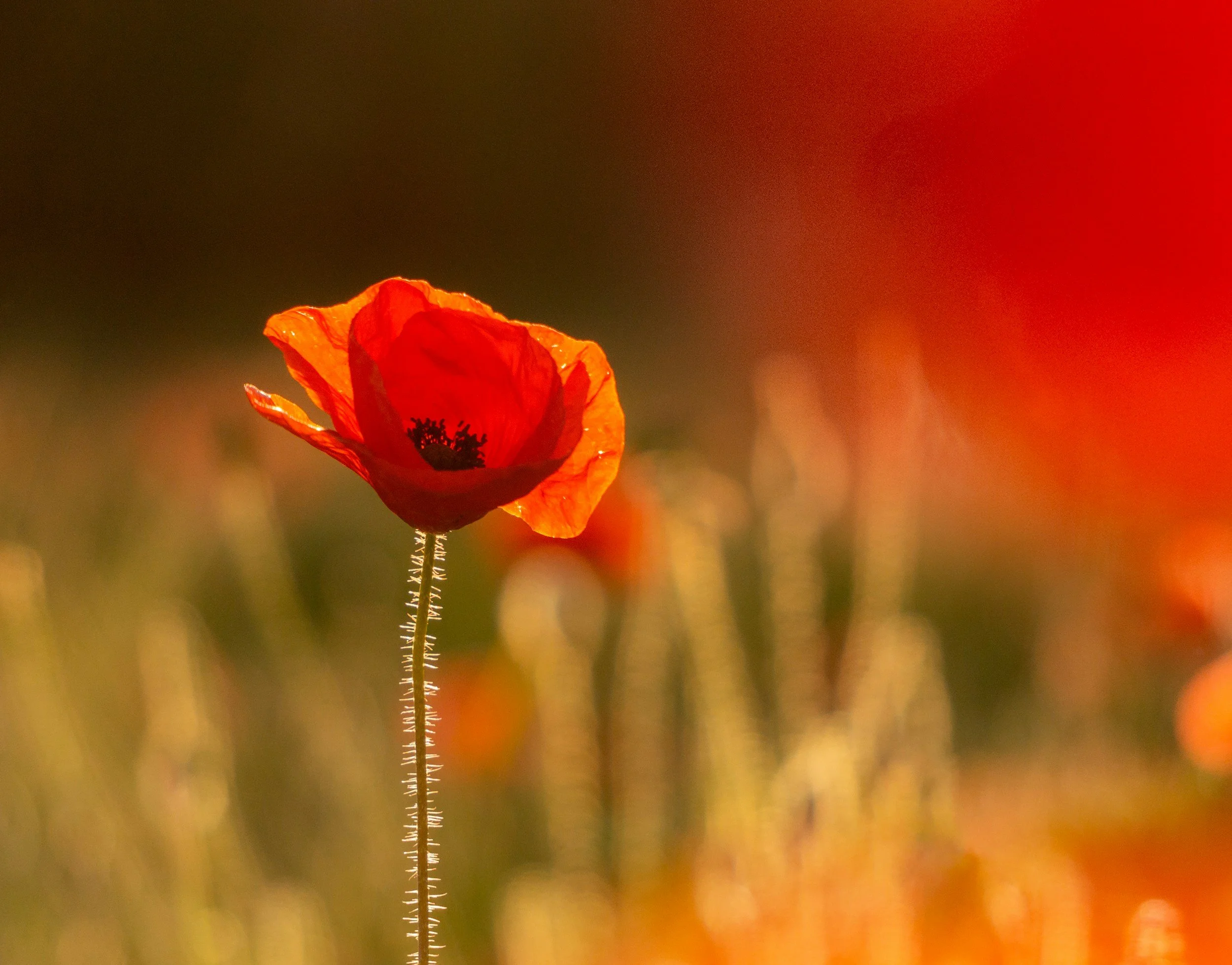
Armistice Day was commemorated every year on 11 November to mark the armistice signed between the Allied powers and Germany in Compiègne, France, which brought an end to the fighting on the Western Front of World War I at the "eleventh hour of the eleventh day of the eleventh month" in 1918. It was signed at 5:45 am on 11 November 1918, but the ceasefire officially took effect at 11:00 am – many were killed in those five hours. The first official commemoration was held at Buckingham Palace in London on 11 November 1919, introducing the tradition of a minute of silence to remember our fallen sons and daughters. The red poppy became the enduring symbol of remembrance, inspired by the war poem "In Flanders Fields" written in May 1915 by Canadian military doctor, Lieutenant-Colonel John McCrae. (He wrote it during the Second Battle of Ypres after presiding over the funeral of close friend and fellow soldier, Lieutenant Alexis Helmer).
Following World War II, Armistice Day was renamed Remembrance Day in Australia and the Commonwealth to honour all military personnel who died or suffered in all wars and conflicts. Australians observe one minute of silence at 11:00 am on 11 November all around the nation at local war memorials – well, some still do. As a young boy in Primary School, Remembrance Day was an important and solemn day. Wherever we were, in the classroom or in the quadrangle, or on the cricket pitch, the announcement would come over the loudspeakers that in a few moments everyone was to stop what they were doing. Right where we were, on the dot of 11:00 am, we paused for a minute of silence to gratefully remember those fallen in war, who paid with their lives the cost of freedoms we must never take for granted. There was utter silence and stillness on those days. Perhaps, they echoed down the decades the eerie silence that becalmed the trenches on the western front, when the artillery fell silent and the bombs stopped exploding. It must have been a strange, trepidatious silence for the battle-weary soldiers on either side of the lines.
After that minute of silence the last post was played, then the school captain would recite “In Flanders Fields”. We all felt the solemnity of the moment. The weight of it. We were taught about it in class. There was reverence for the sacrifice – forget the politics! There were no protests, no disrespect – and none of it was an inconvenience. We all gladly and gratefully paused to pay our respects. Almost all of us in those days had a family member lost, wounded or returned traumatised from WW I, WWII and Korea. My own paternal grandfather returned from WWII maimed and angry, his life and family forever wounded and ruined.
I rose from my desk at around 11:09, the weight of the sacred sacrifice of my fallen brothers and sisters heavy in my heart. And I was incredibly grateful for what they died for me to have. I was somewhat aggrieved that none of those I saw today even realised that it was November 11th or what it meant. The sacredness and solemnity of the day seems to be fading in our nation’s collective memory, and especially in our local communities. Mention of it didn’t appear in the daily newspaper until page 9. It should have been on the front page. The arrival of many newcomers to Australia in the last 40 years (and this is NOT a criticism!) most welcome as they are, who have no knowledge of our history – apart from the wokeist, black armband view of history promulgated in our education system – have no way of knowing how important November 11th is. They don’t know the cost our nation paid in blood for our way of life – and what purchased their future in their new country. We need to share the story, as I am doing here, and never stop remembering. If we fail in this, it is to the loss of our own humanity, and life becomes cheap and callous. To remember something precious – someone loved and lost to us - is a deeply sacred act. It is an intrinsic, existential human thing – a sacred duty that keeps something very valuable alive in our collective memory. Jesus knew this well – the power of remembrance.
Luke 22:19 (ESV)
And He [Jesus] took bread, and when He had given thanks, He broke it and gave it to them, saying, “This is My body, which is given for you. Do this in remembrance of Me.”
Of all the things that the thief on the cross, next to Jesus on Calvary’s hill, could have asked for as death approached him, of all the things, he asks with his dying breaths to be remembered. Luke 23:42 (ESV) And he said, “Jesus, remember me when you come into your kingdom.” He did not want to be forgotten. This is a deeply human thing that is embedded deep in our sense of humanity and worth before God. And so, we pause to remember with deep gratitude the sacrifices of lives that have ensured so much blessing for us today, on Remembrance Day. There is no greater love than this.
John 15:13 (ESV) [Jesus] “Greater love has no one than this, that someone lay down his life for his friends.”
I plead with you, don’t miss the opportunity to pause wherever you are on Remembrance Day number 109, and give thanks and honour the men and women we’ll never meet who have given their lives to ensure our liberty and way of life. Do not remain silent when this history is being trashed by wokeists whose freedom to criticise and denigrate was paid for with the blood of Australia’s sons and daughters long ago.
“In Flanders fields the poppies blow
Between the crosses, row on row,
That mark our place; and in the sky
The larks, still bravely singing, fly
Scarce heard amid the guns below.
We are the Dead. Short days ago
We lived, felt dawn, saw sunset glow,
Loved and were loved, and now we lie,
In Flanders fields.
Take up our quarrel with the foe:
To you from failing hands we throw
The torch; be yours to hold it high.
If ye break faith with us who die
We shall not sleep, though poppies grow
In Flanders fields.
Lest we Forget.
Ps Milton
[Sources: Australian War Memorial website; The History of Australia, by Manning Clarke; Wikipedia; and Gallipoli, by Les Carlyon]